+86-7996790781 office@chemshun.com
- Product Name
- Product Keyword
- Product Model
- Product Summary
- Product Description
- Multi Field Search
Views: 10 Author: Pingxiang Chemshun Ceramics Co.,Ltd Publish Time: 2026-02-24 Origin: Pingxiang Chemshun Ceramics Co.,Ltd


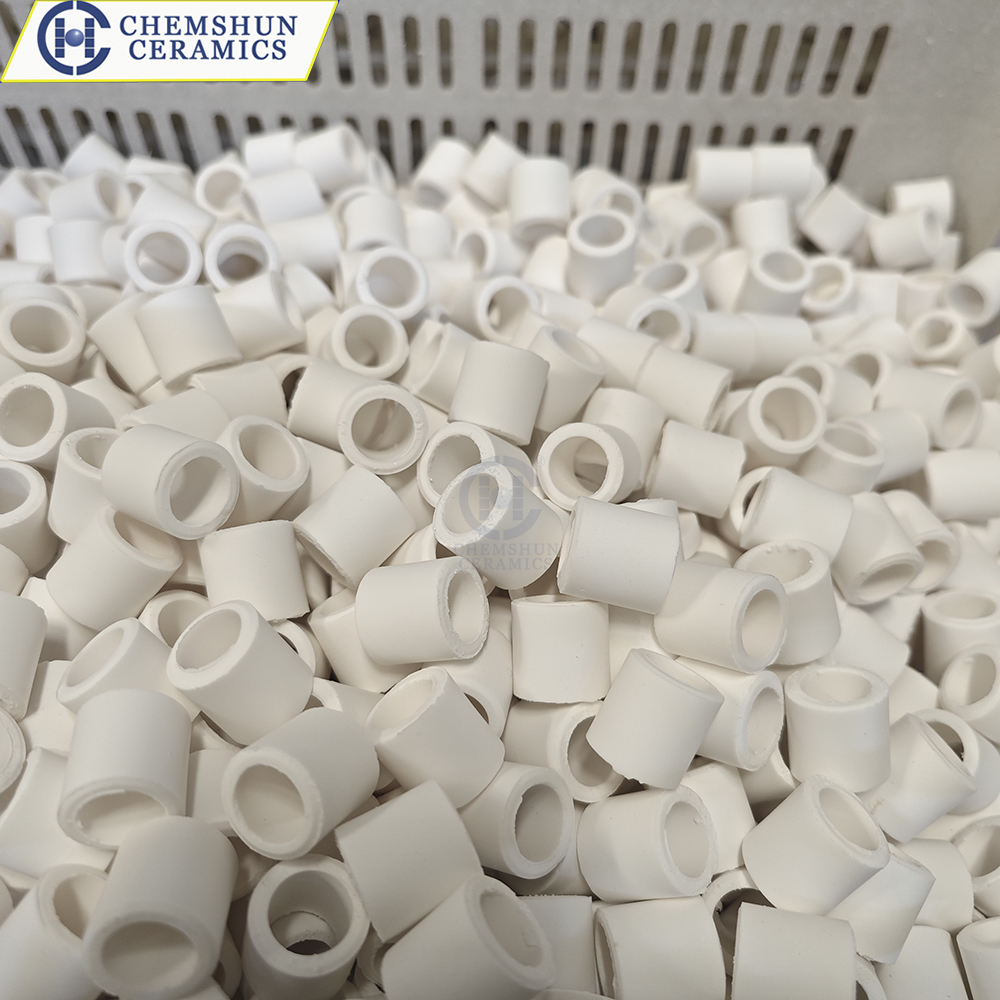
Ceramic Raschig rings are one of the earliest invented random packings in chemical engineering, named after the German chemist Friedrich Raschig. Their standard geometry is a hollow cylinder with a height equal to the outer diameter. Industrial-grade ceramic Raschig rings are typically manufactured from high-alumina, low-iron clay through high-temperature sintering (approx. 1300-1350°C). They exhibit excellent chemical corrosion resistance, withstanding all inorganic acids, organic acids, and various organic solvents except hydrofluoric acid.
Correctly selecting the size of Raschig rings is crucial for ensuring mass transfer efficiency and operational flexibility. Common nominal sizes of ceramic Raschig rings range from 6mm to 150mm . The installation method primarily depends on the equipment diameter and ring size: rings smaller than 100mm in diameter are typically installed using the random dumping method to create a random void structure; whereas rings larger than 100mm are often arranged using the stacked (orderly) method to reduce bed resistance and increase capacity . Technical data for the DN50 specification (50×50×5.0mm) indicates a bulk density of approximately 465 kg/m³, a specific surface area of about 85 m²/m³, a void fraction of up to 81%, and approximately 5,600 pieces per cubic meter. During design, the required packing bed height and column diameter must be calculated based on the gas-liquid load to ensure the operating gas velocity remains below the flooding point.
Due to the brittle nature of ceramic materials, the installation process for ceramic Raschig rings must strictly follow operational procedures to prevent breakage. The wet filling method is recommended: after installing the support grid, fill the column with water to a level at least 1 meter above the packing bed, then slowly dump the rings onto the water surface, allowing the water to cushion impact and reduce damage . If dry filling is necessary, use a chute or fabric bag to control the dropping height to less than 1.5 meters, and never throw the rings directly from a height . Material should be distributed evenly from the column wall toward the center, and the bed surface should be leveled every 0.5 to 1 meter of fill height to prevent bridging or uneven density. After installation, the levelness of the top packing surface must be checked, with a permissible deviation of no more than ±5mm/m, and the local breakage rate should be less than 5% . For columns packed in sections, liquid redistributors must be installed between sections to correct wall flow effects.
In industrial operations, ceramic Raschig rings primarily serve as contact media for gas-liquid mass transfer processes. Their applications span drying towers, absorption towers, cooling towers, and scrubbers in petrochemical, metallurgical, and environmental protection industries . During operation, it is essential to ensure uniform liquid distribution from the distributor, with coverage reaching over 95% of the column's cross-sectional area, to prevent dry spots that reduce efficiency. Although Raschig rings have a simple structure and low cost, their fluid distribution performance is relatively limited and prone to channeling . For applications requiring higher efficiency, improved packings like Pall rings or Cascade rings may be considered; however, under harsh conditions involving high temperatures and strong corrosion, high-alumina ceramic Raschig rings still offer irreplaceable advantages . Regular monitoring of column pressure drop and separation efficiency can indicate whether the packing bed is clogged or damaged, allowing for timely cleaning or replenishment.